A Humble E-biker's Wishlist
- Written by Chris Crockett
- May 29, 2026

I own an e-bike. I used it as my only form of transportation when I lived in Portland, now I only ride it when the stars align, which means I ride it less than I should. Still, every time spring and summer come around in Georgia, I'm struck by the same thought: we are so close. The infrastructure gaps, the cost barriers, the policy blind spots, and general opinions—none of these are hard problems in isolation. In fact, many of the solutions already exist somewhere. And as gas prices continue to rise and cities strain under traffic and emissions, they’re becoming increasingly hard to ignore. There’s unfinished business that needs solving!
So, here's my wish list. A few of the things that are already happening somewhere that could be happening everywhere.
Rebates That Actually Move the Needle
A quality e-bike runs $1,500 on the low end. A cargo bike that can genuinely replace a car for daily errands? Closer to $3,500. That's a real purchase barrier for most households, and a $200 rebate doesn’t meaningfully reduce it.. Colorado ran an income-tiered e-bike rebate program a couple years back and it sold out almost instantly, which tells you everything about latent demand. Utilities have a direct financial interest in transportation electrification (load growth, grid flexibility, decarbonization mandates), which makes them natural co-funders for this. The math works. The desire is there. It’s just a matter of pooling together the money and making it happen.
The ask: design joint utility-municipal rebate programs sized at 20–30% off the purchase price, with higher tiers for cargo and family configurations, and even higher-tiers for income-eligible buyers.
Infrastructure That Isn't Just Paint
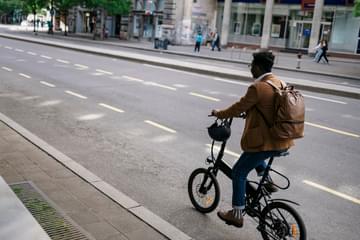
An e-bike can hit 28 mph. That's not really bicycle speed but it’s not car speed either. I’m part of the problem, I know, because I get annoyed with bikers on the sidewalk when I’m walking, and I get annoyed with them on the road when I’m driving. So, the solution up until now has been a lane between sidewalk and road — at times just a four-inch painted stripe between a rider and a driver doing 40 miles an hour. I love to see it, but I’ve come to understand why newer riders don’t feel safe in it.
People want separated, protected lanes on the corridors that get them where they need to go. This is the basic condition under which most people will get on an e-bike in the first place. Most won't until then. (Ask anyone who tried to commute by bike, gave it two weeks, and drove forever after.)
The ask: prioritize protected bike infrastructure on high-volume commuter corridors.
This one is a hefty ask, I know. But maybe we can start small with a “bike only” day once a week and build infrastructure after. See what Bogotá, Colombia did for inspiration.
Cargo Bikes as Their Own Category
A well-designed cargo e-bike handles school drop-off, grocery runs, hardware store trips, and weekend errands with ease. For a lot of families, that covers 80% of daily vehicle needs. But nobody's treating it that way from a policy standpoint. It gets lumped in with recreational cycling and taxed, rebated, and parked accordingly. Cargo bikes deserve their own incentive tier the same way light-duty and heavy-duty EVs are differentiated.
The ask: include cargo and family e-bikes in rebate and incentive programs, recognizing them as trip-replacement technology.
Employer Benefits
Federal commuter benefits cover transit and parking. E-bike commuting, often faster than transit in most mid-size cities and cheaper than parking anywhere worth working, gets nothing. Some employers are ahead of this already (those working toward sustainability targets), but it's still treated as a perk, not a norm. Utilities and municipalities with serious vehicle miles traveled (VMT) reduction goals have more leverage here than they typically use.
The ask: expand federal commuter benefit eligibility to include e-bike purchase and maintenance and encourage employers to offer matching subsidies. Treat it like a 401(k) match for your commute.
Low-Income Access
The people who would benefit most from cheaper, faster, more reliable daily transportation are often the last to hear about the programs designed to help them. Utilities have been building low-income energy efficiency pipelines for decades. The model exists: income qualification, direct outreach through trusted community partners, and meaningful subsidy depth (more than 10% off please!).
E-bike access programs built on that same architecture could do real work. Community lending libraries. Subsidized repair. Purchase assistance tied to transit corridors. The pieces are there.
The ask: develop low-income e-bike programs co-designed with community organizations, funded at meaningful levels, and held to the same accountability metrics as other equity programs.
This is work RI is already helping advance. Through our partnership with the Portland Clean Energy Community Benefits Fund (PCEF), we supported the launch of an e-bike program this spring that expands access to standard e-bikes, adaptive e-bikes, and cargo e-bikes — helping more people find affordable, practical transportation options that meet their everyday needs..
Somewhere to Park the Dang Thing
This one sounds small. I’m starting to realize it isn't. If you’re investing $2,500 on an e-bike, I’m guessing you don’t want to leave it on a sidewalk post and hope for the best. You definitely don’t want to haul it up three flights of stairs when your office building has nowhere to put it. Secure, covered, ideally monitored bike parking with a charging outlet is not complicated to provide. It costs a rounding error compared to car parking infrastructure. The fact that it's still rare in new construction is kind of a zoning gap, in my opinion.
The ask: update building codes to require secure bike parking in new residential and commercial construction, with retrofit incentives for existing properties.
Here’s the good thing. Every item on this list exists somewhere in some form. The work is scaling what works and filling the gaps that remain.
The e-bike revolution just needs a little institutional follow-through and... maybe a covered rack.
Related Energy Resources
Explore Resource Innovations' transportation electrification insights.