Chris’ Corner: EVs for the Long Haul—Let's Talk Road Trips
- Written by Chris Crockett
- March 19, 2026

Happy March everyone, and welcome back to my blog series, Chris’ Corner. Anyone else excited for Spring? It’s basically knocking the door down here in Georgia, and if you're anything like my Midwestern coworkers, that means road trip season is starting soon. Today I want to talk about a question that comes up every time I tell someone I work in the electric vehicle (EV) industry: "What do you do on a long road trip?"
First, a brief cultural note. I spent the first 10 years of my life in the Midwest, where a four-hour drive is just another Tuesday. For some reason, our friends in the central part of the U.S. don't think twice about loading up the car and heading somewhere that takes half a workday to reach. (Kansas City to St. Louis? Barely worth packing snacks!) And if the destination calls for a proper road trip? People will happily tackle drives to Atlanta, Colorado, Texas, or even the Florida Panhandle—eight, 10, sometimes 12 hours in the car—without breaking a sweat. I left Illinois too young to claim this for myself—in fact, I’m quite the opposite of many of my family members. If I have a two-hour drive ahead, I’m downloading my favorite podcast, queuing up five audio books, adding the RI Road Trip playlist to my lineup, and squirreling away rations like it’s the apocalypse... So, when people ask me whether I'm nervous about road tripping in an EV, I genuinely think they’re scared of getting bored, because that’s the real concern, right?
Nah. It’s range anxiety more than anything. That’s a real and reasonable feeling, but it's also one of those things that tends to dissolve the moment you experience a long EV trip.
Let me share what I've learned.
The Headline (Because I Always Frontload)
Road tripping in an EV is different from driving an internal combustion engine vehicle, but it isn't harder. Once you understand the planning rhythm, it will become second nature. You're trading the occasional gas station stop for a slightly more intentional approach to route planning, and the tools to help you do that have gotten really, really good.
The Mindset Shift
The biggest adjustment for new EV drivers is letting go of the "fill up when empty" reflex. With an EV, you should be thinking more like a phone than a gas tank. You charge when you can; you don't necessarily wait until you're at 10% and you plan charging stops ahead of time rather than waiting until you’re running low.
The other thing worth letting go of is the idea that every charging stop needs to get you to 100%. That's actually the slowest way to do it. EV batteries charge fastest in the lower ranges and slow down significantly above 80%. So don’t worry about getting much higher than that; you'll spend less time sitting there and put less wear on the battery in the long run.
Before I learned this, I once stopped at a DCFC and was excited when I got my rental’s battery from 5% to 80% in about 15 minutes. I was less excited when another 45 minutes went by and I was still not quite at 100%...
Planning Your Route
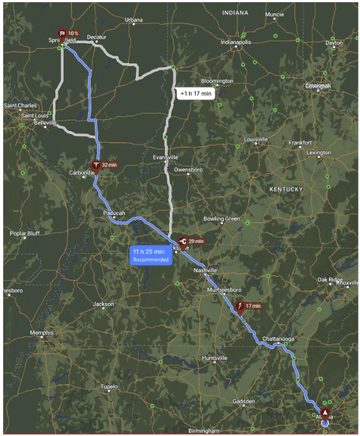
"Be Prepared”, boy and girl scouts. A plan is where most of the range anxiety goes away. A few tools have made this really straightforward:
A Better Route Planner (ABRP)is the gold standard. Plug in your vehicle, your starting state of charge, and your destination, and it maps out charging stops—including how long to charge at each one and what percentage you'll arrive with. It accounts for elevation, temperature, and your driving speed. I've found it to be remarkably accurate.
PlugShareis great for validating charging stops, especially if you're heading somewhere off the beaten path. The real-time, user-submitted check-ins tell you whether a particular charger was actually working last Tuesday—which matters more than you might expect.
Your car's built-in navigation, if it's EV-aware (most newer ones are), will also route you through charging stops and can pre-condition your battery before you arrive at a fast charger to optimize charging speed. Worth using in tandem with ABRP.
One quick practical tip: Don't just plan for the charging stops you expect—take note of one backup option per segment. It takes 30 seconds in ABRP and it'll give you peace of mind.
Rules of Thumb for the Road
I'm a Pareto Principle person, so here's the 20% of things that account for 80% of a smooth EV road trip:
Charge to 80–90% before you leave, not 100%. Unless you're starting a long stretch where you'll need every mile, stop at 90. The last 10–20% of charge is the slowest and hardest on the battery over time.
Fast chargers are your friend on road trips—just not at home. I talk a lot about avoiding DC fast charging (DCFC) in everyday life, and I mean it. But road trips are the exception. DCFC exists for this. Use it. Just remember that charging speed slows significantly after 80% (getting tired of me saying that yet?), so plan your stops accordingly.
Cold weather matters. If you're road tripping in early spring and temperatures are still below 32 degrees F, budget for 15–25% less range than your car's rated estimate. Precondition the battery before you hit the highway if your car supports it—same principle as warming up the cabin while plugged in.
Drive at 70, not 80. I know. I know. But EV range is genuinely sensitive to speed in a way internal combustion engine vehicles aren't. Dropping from 80 to 70 mph can add meaningful range on a long leg. Do I follow this advice? No. I live in Atlanta, and I’m convinced half of us have watched the Fast and Furious franchise too many times. But I assure you I would follow this rule if I was on a road trip.
Don't stress about small detours for charging. Most major fast charging corridors sit right off the highway—five minutes off and back on. Factor that into your mental model of trip time so it stops feeling like a sacrifice.
Not every EV is meant for road trips. Just like not every bike is meant to be taken off road. If you’ve got an old, Nissan Leaf that’s getting 85 miles on a full charge; I suggest you leave it at home. I’m sure that vehicle could maybe do the job, but I think she’s more comfortable as a city commuter. A battery that can get you at least 200 – 250 miles per charge is preferred.
What About Charging Costs?
Fair question. Fast charging on the road is more expensive than home charging—that's just the reality. But even at public fast charger rates, you're typically still paying less per mile than gasoline (especially right now). The savings narrow on road trips, but they don't flip. And if your vehicle came with a complimentary charging plan, the math gets even better.
That’s it for today, folks! Next time, I want to talk about eBikes!
Some Questions and Answers
Q: How long do I need to stop to charge?
A: Plan to spend around 25 minutes charging at a DCFC
Q: Can I charge enough during a quick food or restroom stop?
A: Yep! That’s actually my recommendation. Instead of trying to charge to full, try to stop regularly for little breaks and get a little juice while you’re at it.
Q: Do charging prices vary by network or location?
A: Yes, actually. To the point where you may pay double for a particular DCFC. It depends on the network, location, and who owns the chargers, because owners set their own rates. You’ll usually get the best rates from a Tesla charger, while EVgo and Chargepoint tend to be on the more expensive side.
Q: Do I need multiple apps or memberships to pay?
A: No. This has been an issue for a little while, but it’s being addressed now. Most new chargers have tap to pay options. You can download OEM-specific apps if you want to take advantage of lower costs that come with being a member though.
Q: What if I can’t find DCFC?
A: Level 2s and wall outlets will work in a pinch. Plug in and use that time to find a DCFC.
Q: How much faster is DC fast charging compared to Level 2?
A: It’s so much faster. The average commercial L2 has a power rating of 7.2 kW, DCFC is usually 50 kW or more. That means you’re charging seven times faster.
Q: Does using AC/heat reduce my range significantly?
Both affect your range. Heating more than cooling, though! Expect to lose about 5% of your range using AC; expect to lose around 20% of your range when heating on a cold day. Remember to use those tips we talked about to decrease these losses—seat and steering wheel warmers instead of full cabin heating.
Related Energy Resources
Explore Resource Innovations' transportation electrification insights.