Reviving Legacy Load Flexibility Through Innovative Data-Driven Strategies
- Written by Resource Innovations
- March 20, 2026
Overview
Evergy is an electric utility providing reliable, affordable, and sustainable energy to over 1.7 million customers across Kansas and Missouri. As part of its demand side management strategy, the company is expanding its investment in demand response (DR) to help reduce energy use during periods of peak demand. The residential thermostat DR program includes two customer groups: using legacy one-way thermostats that receive but cannot send load control signals, and customers using smart wi-fi thermostats.
Program Snapshot
Opportunity
Evergy has demand reduction goals of 86.7 MW in Missouri and 45.8 MW in Kansas in 2025. To help Evergy meet its 2025 goals, Resource Innovations (RI) is implementing innovative strategies that align with their broader demand-side management (DSM) efforts. RI's approach drives participation, enhances customer satisfaction, and builds on the strong foundation of strategic and operational support we already provide.
Solution
Evergy partnered with RI to administer its Home DR program and to guide the utility's broader load flexibility strategy. A key area of focus was evaluating the performance of legacy one-way thermostats and determining how to transition these devices without compromising customer satisfaction or driving up program costs. While aging, these devices still offer meaningful value, making a full systemwide replacement impractical.
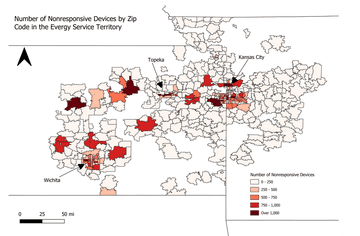
Recognizing this, RI prioritized a data-driven approach to diagnose performance issues and identify targeted solutions. RI conducted a comprehensive operability assessment to pinpoint why certain devices were not responding, quantify the extent of the problem, and outline cost-effective opportunities to restore functionality.
Clustering analysis revealed that approximately 80% of the legacy thermostats were unresponsive during DR events. Yet, responsive devices achieve an average 1.12 kW per-customer load reduction—indicating significant potential if inactive devices are re-engaged.
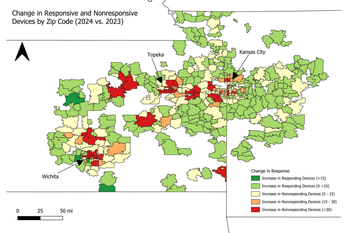
A spatial analysis of the non-responsive devices revealed geographic “dead zones” in rural eastern Kansas. After ruling out customer-driven factors such as opt-outs or unenrollment, RI traced the root of the issue to communication failures, likely caused by inoperable paging towers that prevent control signals from reaching customers.
By identifying these specific infrastructure challenges, RI equipped Evergy with clear, actionable insights to target system improvements, improve device operability, and strengthen the long-term performance of the Home DR program. As a direct result of this work, Evergy was able to add 7 MW to its DR accreditation in collaboration with its evaluators.
"Resource Innovations stood out as a demand response partner because of their strategic vision and proven ability to optimize and scale programs. We’re excited to collaborate with a team that’s focused on driving real value for both our customers and the grid."
Kevin BrannanSenior Manager, Distributed Energy Resources Programs
Next Steps
RI is collaborating with Evergy to conduct coverage map analysis and paging signal field tests to identify communication gaps. Based on the findings, Evergy will install transmitters in low-coverage areas and upgrade portions of the paging network to improve device operability, restore DR capacity, preserve accreditation, and enhance cost-effectiveness.
RI and Evergy are coordinating with tower network providers, assessing repair costs for towers in ZIP codes with many non-operable thermostats, and evaluating the cost-effectiveness of repairs versus transitioning customers to smart thermostats.
Next, Evergy and RI will conduct a switching survey to assess customer interest in upgrading from one-way devices to smart thermostats, covering current setups, willingness to switch, installation preferences, preferred incentives, and barriers. Survey insights will guide targeted outreach and prioritize customers most likely to remain enrolled after the upgrade.
This initiative demonstrates how collaboration, analytics, and rapid action can improve DR reliability and ensure long-term grid benefits for Evergy customers.
Stay tuned for part 2 where we will explore the results of the switching survey and the strategies implemented to re-engage customers and maximize program impact.
Take it With You
Want to revisit these insights later? Get your own copy.