EV Ghost Stories
- Written by Chris Crockett
- October 30, 2026

This month, let’s sit around the campfire and talk about some spooky EV (electric vehicle) stories I’ve heard over the years.
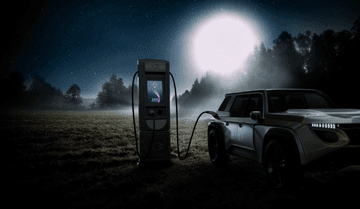
Happy almost-Halloween, Reader, and welcome back to my corner of the internet. This happens to be my favorite time of the year, so I wanted to do something different for this entry. I’ve rounded up five ghost stories from the EV industry: two myths I’d like to put to rest for good and three real stories, each with something to teach us about the industry.
Myth #1: There’s a Vampire in the Garage
It was a cold, stormy night. The garage was dark except for a bulky shadow that, to the untrained eye, looked like a car. But no! It’s sinking its teeth into the circuitry of your home, drawing more power than it needs, draining bank accounts across the country with too-high energy bills! 🧛
Heard this one before? Well, rest assured, it isn't true! Home EV chargers are not like cable boxes or gaming consoles that passively leech power even when you’re not actively using them. ENERGY STAR® test data for one certified Level 2 charger shows about 6 watts idling with a car connected and about 4 watts with nothing plugged in. Leave 6 watts running all year, and you get roughly 50 kWh, which is under $10 at typical rates. So you can save your garlic for the real vampires.
The real monster here is sitting at 100% for weeks. Recurrent, a company that tracks battery health in used EVs, counts keeping a car plugged in and full without driving it much among the habits that wear batteries down. Their advice? If you leave your EV plugged in, set a charge limit. Many EVs cool the battery at a lower temperature when they’re connected. Every automaker is a little different (Recurrent says to leave a Hyundai plugged in, while Ford has said to leave a Mach-E unplugged), so check your manual.
Verdict: myth. Set a charge limit and sleep easy. Also, speaking as a managed charging guy, a plugged-in EV is my favorite kind of EV.
Myth #2: The Fire That Wasn’t (Luton, England, October 2023)
In October 2023, a fire tore through a parking garage at London Luton Airport with up to 1,500 cars inside, and part of the structure collapsed. Social media decided there was something witchy afoot. One of the cars was not like the others. Put that EV on trial! 🧙♀️ This is the kind of incident that reinforces the myth that EV batteries are prone to catching fire.
But, the local fire service said the first car to burn was diesel, not electric or hybrid, and video traced it to a 2014 Range Rover Sport. (The Range Rover in question has declined to comment.)
Verdict: myth. There is a too common belief that EV batteries have a tendency to explode or catch fire. This is the “Jaws effect” that often comes when new technologies hit the mainstream. In other words, sensationalized media coverage of rare EV fires has distorted public perceptions of how safe EVs actually are.
Real #1: Ghost Stations (U.S., 2024 to 2026)
All across the United States, drivers encounter empty parking lots with abandoned charging stations that stand like relics. Some say they aren’t chargers at all, but beacons for extraterrestrials. Beware plugging in, lest you be abducted next. 👽
If you drive an EV, you probably know this one. The app says the charger is available, you roll in with 9% battery remaining, and the screen is dark. J.D. Power, in its 2026 study, found that 12% of public charging visits ended without a charge—the lowest rate recorded in the study to date. That’s down from 14% in 2025 and 19% in 2024. The most common reason for a failed charging visit in the 2025 study was a charger that was broken or out of service. One in eight failed visits is still too many, but this spooky scenario is getting less common, and J.D. Power credits newer, faster chargers at bigger sites for a lot of the improvement.
I’m going to be straightforward with the next few.
Real #2: The Orphans (Fisker, 2024; Lion Electric, 2024 to 2025)
Modern EVs lean heavily on software, which means they need the company that wrote it to stick around. When Fisker filed for bankruptcy in June 2024, roughly 11,000 owners of its all-electric Ocean SUV were left with vehicles that depended on Fisker’s software and servers. After the company’s collapse, owners lost remote connectivity and cloud features, and a pending software recall got stuck, until owners formed their own association to keep the cars running. (Imagine your car’s tech support becoming a group chat.)
This happened for school districts too, where the stakes were even higher. Lion Electric, a Quebec-based electric bus manufacturer, sold roughly 3,400 buses in the U.S. before going bankrupt. In 2025, the company’s new owners said they wouldn’t honor warranties on buses sold outside Quebec, leaving U.S. school districts—including some that used EPA Clean School Bus Program funding to buy the vehicles—with limited options for support.
Real #3: The Kill Switch (Oslo, Norway, 2025)
In 2025, Ruter, which runs about half of Norway’s public transit, put two new electric buses through a security test to see what systems could communicate with them remotely. One was manufactured by China-based Yutong. Ruter found that Yutong had direct digital access to each of its buses for updates and diagnostics, including the battery and power systems, through a Romanian SIM card. This access could, in theory, be exploited to stop a bus or disable it. Ruter tightened its security requirements, and Denmark’s own investigation landed in the same place in January 2026.
Nobody actually shut a bus down remotely in this test. But the findings highlight a broader issue: connected vehicles and networked chargers can create remote-access points that need to be secured. It’s a challenge many utilities face, too, as we modernize the grid and connect more energy assets. Spooky without my embellishment!
What These Stories Tell Us
The real stories share a theme: an EV is only as dependable as the systems and people around it. The charger someone has to maintain, the company that has to stay in business, the software someone else controls, the person answering the call, and the grid that has to stay on all matter. None of that should scare anyone off an EV. But it does give people like me—who design the programs a pretty clear assignment: take everything around the car as seriously as the car itself.
Happy Halloween. Plug in, set your limit, and save your fear for something else. But if someone wants to pitch a movie idea for a haunted EV, I’d very much like to see it.
Related Resources
Explore Resource Innovations' clean energy transition insights.